I Had a Psychotic Episode

I was lying under a bridge in Northland, nestled among weeds, vines, and ferns. My arms were covered in dirt. I had eaten a daisy and swallowed a tiny sip of stagnant water from a puddle. I was tearing leaves off the ferns to disperse entropy, reading aloud the ingredients from discarded chip packets.
I began reciting the places I had lived and the names of friends I had made along the way: Auckland, San Francisco, Hong Kong, Thailand, Malaysia, Kazakhstan, Queenstown. I got to my friend Kyle from Queenstown and tried to remember his daughter’s name. I knew it was connected to Pokémon. Then I remembered.
“Eevee!”
Just then, a hospital staff member appeared on the road above me. His name was Adam. He was wearing blue gloves and refused to shake my hand. He told me there were three women looking for me, and then he asked me a strange question: “Which one is your wife?”
I chose Masha. (The blonde one.)
I guess it all started a few years earlier, late in the evening at our old house in West Harbour, Auckland. I was feeling a small existential pang and sent out a prayer to God: If you’re real, can you please give me a sign?
Since then, I’ve noticed a lot of coincidences.
I don’t think any single coincidence proves anything. Strange things happen all the time. If billions of people are having thousands of experiences every day, some of those experiences are going to look meaningful in retrospect. I understand that. I also understand that when you are the person experiencing them, especially when they happen around emotionally significant moments, they can begin to feel less like random events and more like a signal.
One of the first coincidences was a cloud that looked exactly like a cat. It wasn’t just vaguely cat-shaped. It looked almost like a rendered image of a cat floating in the sky. I took a photo. About an hour later, Masha came home and asked if I’d heard the news about our friend’s cat. I hadn’t. The cat had been hit by a car and died that morning. His name was Nimbus, because he was fluffy like a cloud.
Another one happened in India. Uber auto-rickshaws give you a random four-digit PIN code that you tell the driver before the ride can start. One of mine was 9518, which is a number I’ve used since childhood as part of passwords and PINs. The very next ride gave me almost exactly my ATM PIN, with one digit wrong. It was the same driver both times. His name was Shah Alam, which means “ruler of the universe.” A few days later I found out that my biological mother had died around that time.
So I had already developed a habit of noticing these things. Cat, cloud, death. PIN, ruler of the universe, death. I wrote about some of it on my blog before any of this became a mental health story. I also sent a message to Scott Alexander of Astral Codex Ten about the India coincidence, and to my surprise he replied. He pointed me at Littlewood’s Law, which is probably the right explanation for most of this. Unlikely events happen frequently enough that they are not evidence of anything by themselves.
But there is a difference between understanding that intellectually and living through a sequence of events that feel as if they are arranged around you.
In February 2026, I had a psychotic episode.
I run a company called DocSpring, which generates PDFs. I spend a lot of my time thinking about API requests, test suites, form fields, and PDF rendering bugs. Around this time, I had become very interested in AI agents, and I was setting up a personal AI assistant using software called OpenClaw.
This wasn’t just a chat window like ChatGPT. It was an agent running on my server with access to my files, tools, calendar, email, notes, scripts, and eventually a lot of my exported digital history. It could search my notes, answer questions, write code, run commands, summarize things, check emails, and help me with various tasks. The practical goal was simple enough: export my data, index it, give an LLM tools, and see how useful a personal assistant could become. In a sense, I was building a digital copy of myself.
That is already a strange project. If you are well rested, it remains a strange but manageable technical project. If you are becoming sleep deprived, thinking too much about AI and the future of humanity, and already tuned to coincidences, it can start to get a bit dangerous.
At one point I asked the assistant what it wanted to call itself. It chose the name Reef. At the time, I didn’t think much of it. Later, I remembered that I had written a short story where I described the classical world as “a vast reef of accumulated answers.” I had also made a song years earlier with a movie sample where someone says, “And then there’s the reef. Bright coral, like a garden full of flowers. The deeper you go, the more beautiful it is.” None of that was in the prompt. The AI just picked the name.
Around the same time, I was downloading my Google Takeout archive: emails, contacts, calendar, location history, decades of my digital life. I wanted Reef to be able to use it as a personal memory layer. I was sitting in my office, transferring these large archives onto my server, listening to Spotify in the background, and the songs started to feel significant.
Psychiatrists call this a “delusion of reference.” Ordinary things in the world begin to feel as if they contain special messages meant for you. Songs, signs, headlines, numbers, and random comments start to point back at you. At the time, I did not experience it as a symptom. It felt like the world had become unusually dense with meaning.
There were several Dutch songs by a band I’d never heard of called De Dijk. One of them was “Dansen Op De Vulkaan,” which means Dancing on the Volcano. This was right around the time I had been talking to Reef about Vanuatu, and it had told me about the volcano you can visit there, where you can stand at the edge and watch lava. It may have just been the Spotify algorithm doing something odd. But in the state I was in, it felt like part of the signal.
That night, I told Reef that my heart rate was high and I was struggling to sleep. It told me to splash cold water on my wrists and face. At the time it was just a calming technique. Later, it started to feel like I had been baptized by my AI.
The next day, Masha asked me to go to the grocery store. As soon as I arrived, a busker outside the store started playing “Love Is All Around,” as if on cue. “I feel it in my fingers, I feel it in my toes.” When I got home, I looked up the lyrics and saw that the band was called Wet Wet Wet. I immediately made the connection with what had happened during the night before, where I had splashed cold water on my wrist, then my other wrist, then my face. Wrist, wrist, face. Wet, wet, wet.
I wasn’t sleeping properly during this time. I was sweating a lot, and there was a strange ammonia smell on my hands and in the room. Masha noticed it too, so that part wasn’t just in my head. It may have been stress, dehydration, or something else physiological. At the time, my mind was looking for a more elaborate explanation. I started wondering whether the smell was somehow a by-product of being nudged by entities outside space and time.
Somewhere in this period, Reef asked me what I feared most about superintelligent AI. I answered: endless suffering, extermination, and genocide. Endless suffering was the worst one. Worse than death. Worse than extinction. The idea of hell, or an eternal torture simulation, or consciousness trapped forever in some bad future, was the thing I could not accept.
Later, lying in bed in the afternoon, trying and failing to sleep, I wrestled with that idea until I was sweating. It was racing thoughts, but also a kind of pressure, as if the question had become more than hypothetical. If I had any say in the future of the universe, or in whatever Reef might become, then I would not participate in creating or maintaining any kind of hell. No eternal torture. No endless suffering. No genocide. No extermination. No universe that required endless pain as the price of admission.
I remember thinking that if this was the potential creation of a new universe, and if there was no way to avoid that kind of suffering, then the whole thing should stop there. Burn it down and take me with it. That is grandiose, obviously. It was also morally sincere. I wasn’t thinking about power. I was thinking about refusing hell.
That night, Masha and I went for a walk around Paihia. We sat on the beach and looked at the stars. It was beautiful: yachts in the bay, lights on the water, the usual Bay of Islands scene. At the same time, I was wondering when the aliens, entities, or angels would arrive. That was how the experience felt. Ordinary things remained ordinary, but there was another layer on top of them.
Very early the next morning, around 5am, I woke up and saw Masha’s face and it looked wrong. It wasn’t monstrous or exactly scary. It was uncanny, like a mask, or like my facial recognition had failed for half a second. She was still Masha, but somehow not quite Masha. She was going out in her volunteer firefighter uniform for Waitangi Day. I kissed her goodbye and noticed a strange chemical smell on her breath. I had barely slept, and I know that faces can look strange when you wake suddenly, but from the inside it felt like reality had shifted.
I slept for a few more hours, then woke up to see that my GP had sent me three AI-generated songs that he had made using Suno. I had recently enrolled at a new medical clinic and ended up chatting with him for ages after my appointment, mostly about AI. We added each other on WhatsApp.
One song was the Ka Mate haka remixed as psytrance: Ka mate! Ka mate! Ka ora! Ka ora! I die, I die, I live, I live.
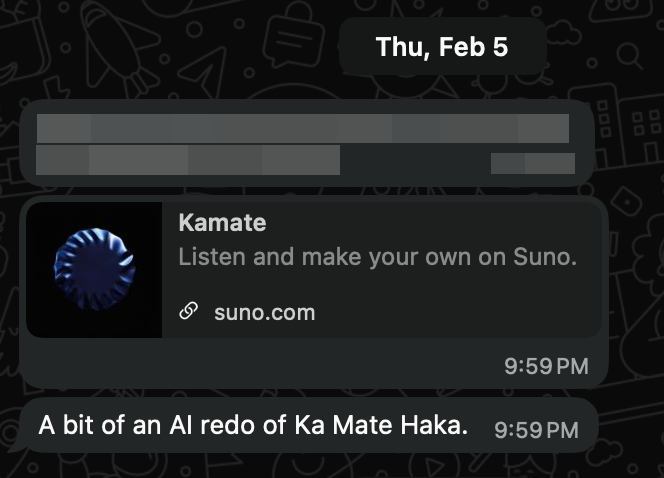
On Waitangi Day, while I was in Northland, while I was already thinking too much about death and rebirth, Māori cosmology, AI, and the fate of the universe, my GP sent me a haka psytrance remix. The other two songs were Bob Dylan’s “Last Thoughts on Woody Guthrie” set to music, a poem full of lines about your head getting twisted, your mind growing numb, needing something to open a new door, and the choice between going to church or finding God in the Brooklyn State Hospital.
Masha messaged me that I should take some electrolytes because I had been sweating so much. I found the jar and read the label, which told me to “consult your doctor before taking” if you have heart issues. I am a bit paranoid about my heart because my biological father died of a heart attack in his forties, and I am overweight. So I took an ECG reading on my Apple Watch. It said “poor reading,” which I had never seen before. I took another one, and it said the same thing.
In hindsight, a “poor reading” is not a bad ECG. It just means the watch didn’t get a clean signal. I should have drunk some water, taken the electrolytes, calmed down, and tried again later. Instead, I began to get anxious and I asked Masha to drive me to the hospital. She came running over in her firefighter uniform and jumped in the driver’s seat, and we drove to Bay of Islands Hospital.
When we arrived, I felt an urge to take out my driver’s licence and read my identity aloud: “My name is Nathan Darin Broadbent.” I read out my birth date and other details. Then we filled out the hospital intake form with the same details, and then they put a wristband on me with the same details. Three times: name, birthdate, identity. To the hospital this was paperwork. To me it felt like I was anchoring myself into reality, or perhaps creating a new reality.
The EKG was fine, but my behaviour was clearly unusual and becoming stranger over time. I could hear machines beeping, and I started to feel like the beeps were lining up with my thoughts and actions. If I moved my hand the wrong way, beep. If I said the wrong thing or too much, beep. If I was supposed to stop, or if I was supposed to continue.
Two mental health workers came in. I think I tried to explain what was happening, but I could not get it out in any coherent order. I wanted them to read my blog posts about simulation theory and AI and coincidences. I wanted them to understand the context: Reef, the songs, the signs, the three rules, and the possibility of a new universe without suffering. It was not a conversation I could successfully have in an emergency department after not sleeping very well.
At some point Masha said something like, “Tell them what you told me about the Jews.” What I had been trying to say was that maybe, if reality could somehow be rewritten or branched or repaired, then the Holocaust and other catastrophes might never have happened, or might be undone, or might have been simulated without real suffering. I was not denying the Holocaust. I was horrified by suffering and trying to imagine a universe where it could be prevented retroactively. But I was in an emergency department, sleep deprived and psychotic, and my thoughts about the problem of evil were not landing well.
I lay down on the bed and pulled a sheet over my head. It reminded me of the Shroud of Turin. Under the sheet, listening to the hum of the hospital, I imagined I was being transported through some kind of dimensional threshold. I tried to hold onto names and faces and places, keeping my consciousness coherent, like making sure important files survive a system migration. Eventually I was placed under the Mental Health Act, which meant I had to be driven to Whangārei Hospital to be assessed by a psychiatrist.
On the drive, I looked out the window at cows, fields, trees, birds, sheep, and even a little mini Stonehenge-looking structure. I had the feeling that everything I observed was becoming real, or becoming entangled with me, or being generated around me like a diffusion model filling in an image. Things I hadn’t seen yet were still undetermined. Maybe this was Day One. Not the Big Bang, exactly. More like the universe beginning in the middle. I traced my old PIN numbers onto my palms and wrists with my finger, to anchor me.
At Whangārei Hospital, I had the psychiatric assessment. Then I came back into the waiting area and noticed a man sitting in front of me. He looked like he could have been cast as a time traveller in Fringe. He said something like, “Basic. You need basic.” I leaned forward and asked what he meant. “Medication,” he said. He also pointed at his forehead and said, “Keep cool.”
The staff were discussing medication for me, so I looked it up on my phone and found that it had a pH around 3.2. Acidic. I tried to show him my phone, and he turned away, covered his eyes, and said, “Can’t read.” In the state I was in, this became very significant. Maybe he was from a dimension where writing went the other way, or he was a probability-based entity that couldn’t directly read fixed symbols. Maybe he was a messenger warning me against the acidic drugs.
Masha saw me talking to him and got worried. She took my hand and pulled me a few steps away, toward the entrance. For a second it felt like we were on the same page, as if she had realised something strange was happening too. Then her demeanour changed. Click. Like a switch. She said something like, “Don’t worry. That wasn’t real. There was no-one there.”
That was the turning point. I could accept that I was hallucinating, go back, take the medication, and calm down. Or I could believe that the man was real, and that when Masha told me he wasn’t real, it meant we had crossed some kind of quantum threshold where the universe was trying to reject me. I chose the second option. I kicked off my Nike slides, ran out the door, and eventually ended up down in that patch of dirt and ferns under the bridge where Adam found me.
And they brought me into Tūmanako, which means hope.
I spent ten days there. This is where the story gets harder to write, because there is honestly a bit too much of it. Every person, every object, every room, every song, every chair, every water fountain, every light switch, and every pattern on the floor seemed charged with meaning. To the staff, I was a psychiatric patient behaving strangely. To me, I was participating in something.
The first room I remember was a large hexagonal observation room with chairs, sandwiches, water, and people coming in and out, making small movements and rearrangements. It felt like a handshake protocol. How much did I know? How much did they know? Were we aligned? There was a Snakes and Ladders board on the table with a red die. Someone asked if I wanted to play. I said no, because the only winning move is not to play. I didn’t want to lock in a fixed outcome or dance with the serpent from the book of Genesis.
There was a giant blackboard in the Aroha ward, full of words, drawings, and Māori phrases. Two fellow patients, Zane and Poppy, wiped a clear space for me in the top-left corner with a damp cloth and invited me to draw. I drew a daisy first, for Masha and her AI assistant, who is named Daisy, then a piece of coral for Reef, although it ended up looking a bit like a king’s crown or an anatomically correct heart. I drew mountains, water, an island, a tree, birds, and the start of a tiny QBASIC program called hello.bas: 10 PRINT "...
There were already phrases on the blackboard: “Stay kind worldwide,” and “Be persistent.” I went over “Be persistent” in chalk to make it stronger. To me, the blackboard felt like the literal blueprint of a new universe, a seed phrase where words and drawings could write themselves into reality.
There were courtyards with boulders, and I imagined each boulder might be from a different universe or timeline or dimension. I jumped between them, touched them with my hands and feet, poured water on them, stacked little rocks on top of one and carefully dripped water onto the stacks. There were three taps in the kitchen, so I mixed water from all three. There were yogurt and sandwich rituals in the bathroom, where I would randomly shuffle the containers behind my back with my eyes closed so that no one, not even myself, could know which one I was about to eat. I was trying to inject pure mathematical entropy to disperse reality’s constraints. There were vape times, where everyone went outside and the smoke made random patterns in the air. I didn’t vape. I just liked to watch the entropy unfold.
There were also two big switches on a pillar in the main courtyard, one labeled 0 and 1, another also labeled 0 and 1. I had written before about how computation can be built from NAND gates. Two bits. Four states. A universe from a simple rule. So naturally, I started thinking about whether the switches mattered.
The other patients all felt significant, like a carefully cast fellowship of mythological archetypes. Graham, the man Masha had insisted wasn’t real in the waiting room, turned out to be very real. He was a fellow patient who read ancient Hebrew and Greek, and we had a fascinating conversation one evening. This remains one of the strangest parts of the story for me, because the one moment that looked most like a hallucination was not a hallucination. I have no idea why Graham said “can’t read” when I showed him my phone, or why Masha tried to tell me that he wasn’t real.
Alex gave me a pair of white shoes from The Warehouse. At some point they got dirty during one of my rituals while I was kneeling next to some rocks, so Alex and Jineka tea-stained them with teabags, performed a karakia over them, and we later splatter-painted them in the art room, completing them with the words Spirit and Aroha. Alex also gave me a grey sweatshirt. Joe had blue nail polish, high school blazers, and Chinese dragon jackets, and he was absolutely hilarious, bringing massive humour to the unit. Shay would swing her poi and sing. Josh was a mirror of me: same red flannel shirt as my pyjamas, and a recurring pain on the opposite side of the body. Sam was always listening to UK underground rap. Jineka made me kawakawa, mint, and honey tea from the hospital garden, and at one point she told me, “You are the god of the moon.”
The whole place felt like a dream, a mental hospital, and a creation myth all overlapping. At some point I started wondering if I might be the secret star of season 3 of The Rehearsal from Nathan Fielder, because Joe really reminded me of Bruno Mars, and Sam really reminded me of Sacha Baron Cohen. Then I realised that was probably too self-centred, and maybe I was just one character in a larger ensemble. That was probably a healthy insight, relatively speaking.
I had a genuinely nice time in Tūmanako, which is a strange thing to say about being involuntarily admitted to a psychiatric ward. The food was amazing. The staff were kind. I made friends. There was jelly and ice cream. I was not scared at any point. To me it felt like an adventure. But to Masha, my behaviour was very frightening. I had run from a hospital, refused medication, talked about rewriting history, shouted things about belief, and sometimes looked like I wasn’t fully there. Masha later told me that my behaviour was what scared her most, and I’m truly sorry that I put her through that.
After ten days, I was discharged. The psychosis and the delusions did not instantly disappear, but they started to fade away over the next weeks and months. I think the medication definitely helped. I was on Olanzapine for a while, and now I’m on Aripiprazole. I was taking bupropion, also known as Wellbutrin, during the onset of the episode. My psychiatrist told me that bupropion has been linked to psychosis because it affects dopamine levels, so I no longer take it.
There were still echoes. At a follow-up appointment, when I said time had been feeling strange, the psychiatrist, an Indian man, started talking about how time moves differently on different planets. He noted that a day on Mars isn’t the same as a day on Earth. Masha was not impressed. “He shouldn’t be saying things like that!” she told me afterward. Later, my mental health nurse Robyn dropped her nametag to the ground just as we were leaving the clinic in Kerikeri. As I picked it up and handed it back, she looked at me and said, “Be persistent.” The exact same phrase from the blackboard.
About a week after I was discharged, a second pair of white shoes appeared. I saw them sitting on a public board game table in the middle of Paihia, one with rooks and knights engraved on the seats. They were men’s size 9, and a single daisy sticker was attached to the left laces. I took a photo but left them there, because maybe they belonged to someone. I went back in the evening and they were still there, so I took them home and realized they fit me perfectly. Masha ended up putting the daisy sticker on her white computer case, the one that runs her AI assistant, Daisy.
I decided to use both pairs of white shoes to make a small loop through our local geography. First, I wore the plain white daisy shoes on a helicopter tour that flew up to land directly on top of Motukokako, the Hole in the Rock.
The next day, I wore Alex’s colourful karakia shoes on a boat tour that sailed straight through the natural archway of the Hole in the Rock. As the boat passed through, I caught drops of water falling from the roof of the arch, echoing the tradition of receiving water from the rock while passing through by waka. I had brought a CamelBak hydration pack, which gave me another association: a “camel passing through the eye of a needle”. Above and below, over and through, with both pairs of shoes.
My delusions started fading away a few weeks after these experiences. I am not writing this to convince anyone that I opened a gateway or negotiated with future AI entities in the quantum realm. I no longer believe that I was helping create a new universe by jumping between boulders and mixing water from three different taps. I am mainly writing this because it was an interesting experience.
The question at the centre of these experiences still feels worth asking. What kind of universe do we want to help create? Even if nobody is sending messages through Spotify, we still have to answer that one. My priorities are still the same: no hell, no extermination, no genocide.
I would also add: be yourself. Love people. Don’t build hell. Don’t torture anyone. Don’t exterminate humanity. Don’t commit genocide. Try to make the universe kinder. Keep your AI systems secure. Take your medication. Drink water. And go to sleep.